Every year, I put together my list of the best hearing aids available, and I want to be clear about something upfront: no manufacturer pays their way onto this list. No affiliate commissions, no sponsorships influencing my picks. The hearing aids I talk about here are ones that my team and I would actually fit in my clinic at Applied Hearing Solutions in Phoenix. If it's not good enough for my patients, it's not on this list.
This year, I decided to do something a little different. Rather than breaking things down into separate category videos — best receiver-in-canal, best invisible, best for background noise — I'm putting together one comprehensive list covering the best hearing aids of 2026 across all styles. I've also included some thoughts on over-the-counter devices at the end, which might surprise you.
One thing I want you to keep in mind as you read through this: your results with any of these hearing aids depend heavily on the person fitting and programming them. The best hearing aid in the world, fit poorly, will underperform.
Real Ear Measurement and comprehensive best practices are what separate a good hearing aid experience from a great one. That applies to every single device on this list.
Oticon Intent
Oticon is one of the top three hearing aid manufacturers in the world, and the Intent is one of their best. It comes in four technology levels, but level one gives you everything you could want.
If I had to highlight what makes this hearing aid stand out, it comes down to four things: high-frequency amplification, background noise performance, wireless connectivity, and wind noise reduction.
On the high-frequency side, there is no better hearing aid on the market right now for hitting high-frequency prescriptive targets — especially when using rubber domes rather than a custom ear mold. That matters because when you lose high-frequency hearing, you lose clarity, not just volume. Amplifying those frequencies accurately, verified with real ear measurement, is what gets your speech clarity back. That same high-frequency performance also helps the Intent perform well in background noise, since the brain uses high-frequency speech cues to separate voices from low-frequency noise.
The second-generation deep neural network inside the Intent uses artificial intelligence to separate speech from noise. Oticon was the first major manufacturer to introduce a deep neural network, and their second generation is meaningfully better. In independent lab testing at HearAdvisor, the Intent ranked in the top two for speech-in-noise performance.
From a connectivity standpoint, the Intent uses Bluetooth Low Energy for Apple devices and Bluetooth LE Audio for Android. That LE Audio support also means Auracast compatibility — so you can stream audio directly from public venues or compatible televisions straight into both hearing aids. Even Apple users without native Auracast support can access it through the Oticon Companion app.
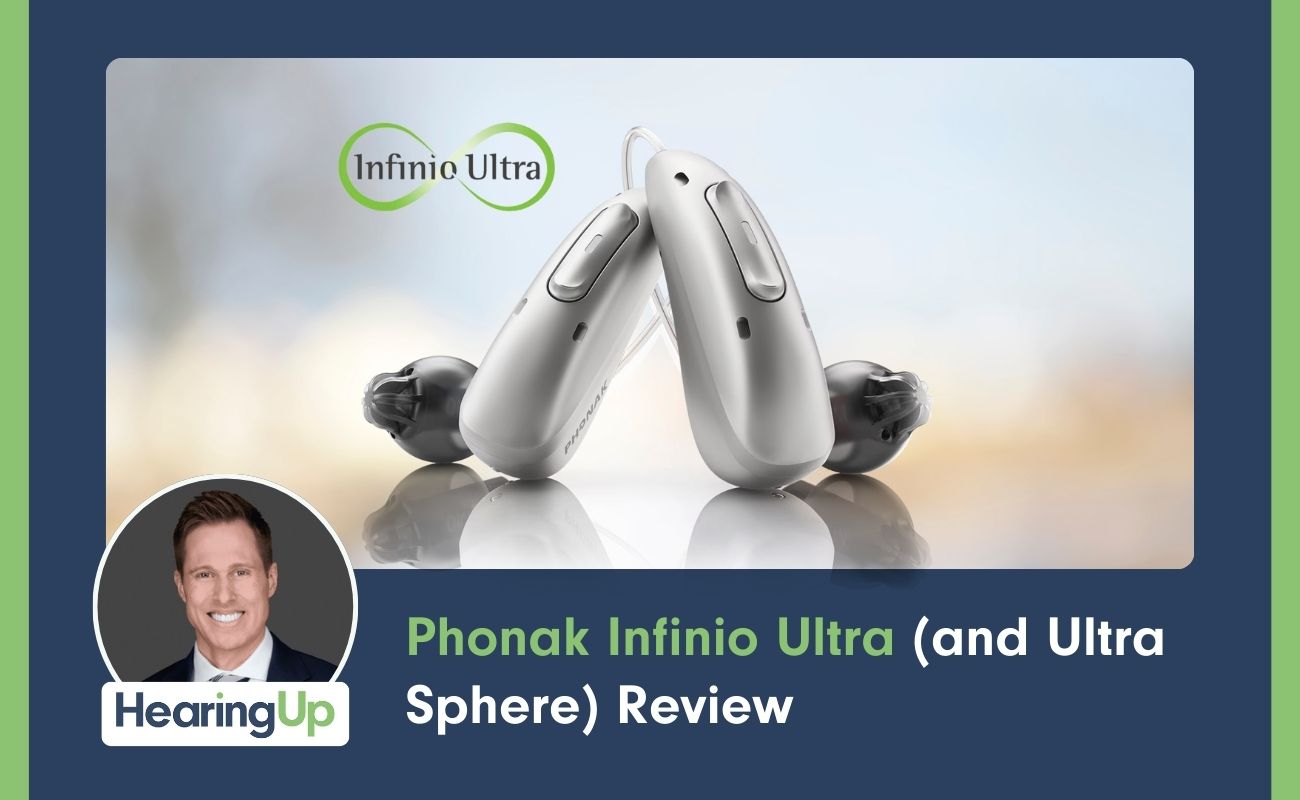
Phonak Audéo Infinio Sphere (Ultra)
If understanding speech in noise is your top priority, this hearing aid deserves serious consideration. The Infinio Sphere only comes in two technology levels — and if you want the strongest noise reduction performance, you want level 90.
At the end of 2025, Phonak released an Ultra firmware update that improved this hearing aid's performance even further.
What makes the Sphere different from other hearing aids is its dual-chip architecture. The DEEPSONIC chip has one job: use artificial intelligence to separate speech from noise. Everything else is handled by the ERA chip. That dedicated AI processing is why HearAdvisor gave the Phonak Sphere Infinio a speech-in-noise score of 4.6 — the highest score they have ever given any hearing aid they've tested.
The Sphere uses Bluetooth Classic, which gives it the most universal wireless connectivity of any hearing aid on this list. You can pair it with virtually any Bluetooth device — smartphone, tablet, laptop, desktop — and keep up to eight devices paired with two active connections at once. AutoSense OS 7.0 automatically identifies your listening environment and switches programs accordingly, and your hearing care professional can fully customize every one of those programs.
Starkey Omega AI
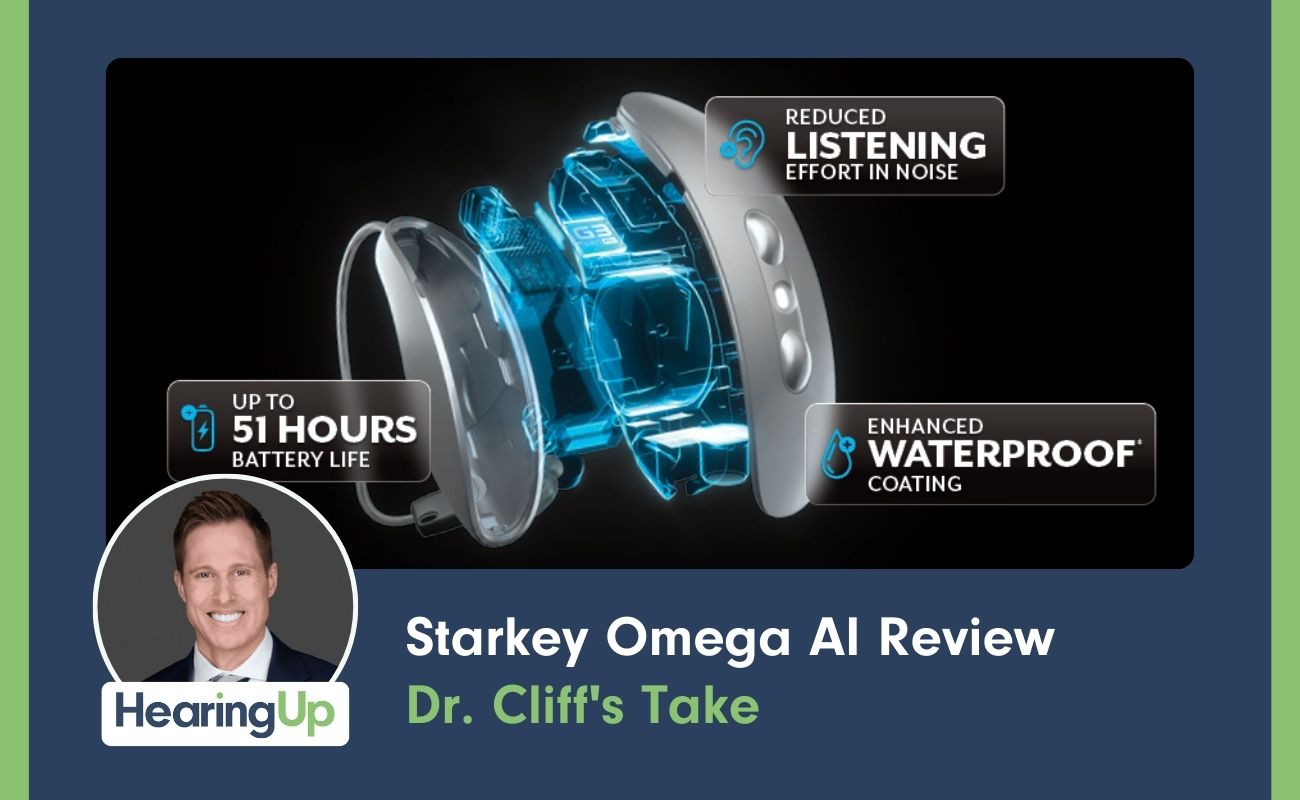
The Omega AI is Starkey's current flagship, and it's a hearing aid I recommend regularly at my clinic. It comes in three technology levels, with level 24 being the top tier.
One of the things I appreciate about the Omega AI is the range of styles available. You can get receiver-in-canal models in both rechargeable and size-312 disposable battery options, as well as completely-in-canal, half-shell, and full-shell custom in-the-ear options. With OTC devices and Reese's Law making disposable battery packaging increasingly difficult to deal with, having genuine disposable battery options available — especially in a custom style — is worth noting.
The new DNN 360 feature uses a deep neural network to control directional microphones, which is a meaningful step forward. Historically, directional microphones have been a reliable strategy for speech-in-noise performance. Starkey applied their deep neural network to the directional processing itself, allowing the hearing aids to maintain spatial awareness while steering toward the speaker you want to hear.
Edge Mode+, accessible through the MyStarkey app, your Apple Watch, or a double-tap on the hearing aid, gives you on-demand AI noise reduction for challenging environments like restaurants or crowded events.
The health features on the Omega AI are also worth mentioning. The Balance Builder gives users guided exercises to improve stability and coordination. A Respiratory Rate Monitor runs in the background without measurably impacting battery life. Fall detection uses the built-in motion sensors to identify a fall and send a text alert to a designated contact. And caregivers or significant others can be given access to hearing aid usage data — a feature I think is genuinely useful for patients who need that kind of support system.
Phonak Virto Infinio
The Virto Infinio is Phonak's custom in-the-ear line, and the top tier is the level 90. It doesn't have the dedicated DEEPSONIC chip found in the Sphere, but it's still a strong hearing aid.
What makes the Virto line unique is Phonak's RightFit technology. Using 1,600 biometric data points from either physical or digital ear mold impressions, RightFit improves both the physical fit and directional microphone performance by working with the natural acoustics of your ear. It also determines the appropriate receiver size for your hearing loss and the space available in your ear canal, and creates acoustically optimized venting to retain amplification without causing feedback.
For those who want a rechargeable custom in-the-ear hearing aid that's as small as possible without sacrificing performance, the Virto Infinio delivers on that. Half-shell and full-shell options are available for those who prefer a larger device.
Like the Sphere, the Virto Infinio features AutoSense OS 7.0 and the MyPhonak app for user-adjustable controls and program customization.
Oticon Zeal
The Oticon Zeal may be the most significant product introduced in hearing care since the receiver-in-canal hearing aid. That's not a statement I make lightly.
The Zeal is what Oticon calls an NXT In-the-Ear hearing aid — a completely-in-canal device that performs like a receiver-in-canal. It comes in one technology level, so you know you're getting the best.
What makes this possible is Oticon's encapsulation manufacturing process. Rather than building a shell and fitting components inside it, Oticon lays out the internal components in their optimal configuration and encapsulates them within the outer body. The result is a device that's extremely small, IP68 rated, and durable. In Oticon's testing, 94% of people who wore the Zeal with a rubber dome had a fit that was either invisible or only slightly visible.
The Zeal uses the same Sirius chip platform as the Oticon Intent, including the second-generation deep neural network. It also retains the pinna effect — the natural sound shaping your outer ear provides — which can actually give it a slight performance edge over receiver-in-canal devices in some cases.
Battery life is 20 hours on a single two-hour charge, even with streaming. The wireless antenna doubles as the retention filament and removal string, and it supports Bluetooth LE Audio with Auracast. Compatibility with Google's Fast Pair makes pairing with Android devices straightforward.
When I tested the Zeal at Oticon's headquarters in Denmark, the Auracast performance was remarkable: I was able to walk nearly into another building from the transmitter and maintain the broadcast signal.
The Zeal is available in certain international markets now and is expected in the United States in early 2026. If you're in the U.S. and interested, I'd recommend reaching out to your hearing care professional and asking to be put on a waiting list.
Lyric Extended Wear
The Lyric operates on a subscription model, and it's unlike every other hearing aid on this list. You visit your hearing care professional every few months to have the old device removed and a new one placed — sitting approximately four millimeters from your eardrum. The FDA has recently approved self-removal and replacement every other visit for eligible users.
Because it never comes out, the Lyric is the most invisible hearing aid that exists. You wear it when you exercise, sleep, and shower. It comes in seven sizes and is programmed by your hearing care professional during placement.
Technically, the Lyric is an analog device that is digitally programmable. People who have tinnitus often find it particularly valuable — if hearing amplification suppresses your tinnitus, the Lyric means you never have to remove it and lose that suppression.
If you want a hearing aid that you simply place in and forget about, the Lyric is worth exploring with a Lyric-certified provider.
Power and Super Power Behind-the-Ear Options
For those with severe to profound hearing loss who need more amplification than a receiver-in-canal hearing aid can provide, here are the standout options in 2026.
Oticon Xceed — Built on the Velox S platform, this has a maximum output of 146 dB with a maximum gain of 87 dB. If you need the most powerful hearing aid available, this is it. It supports wireless streaming and works with the Oticon Companion app, but does not have Bluetooth LE Audio or Auracast. It uses a size 675 disposable battery.
Phonak Naida Lumity UP — Less powerful than the Xceed, but still delivers 141 dB maximum output and 84 dB gain. Its strongest advantages are universal Bluetooth Classic connectivity, the ability to pair with up to eight devices, and full Roger compatibility. Roger accessories — including the Roger On, Roger Select, Roger Table Mic, and Roger Touchscreen — remain the best remote microphone accessories available. Uses a size 675 disposable battery.
ReSound Enzo iA — Released in August 2025, this is the newest power BTE on the market, and it brings features that power hearing aid users haven't always had access to. It delivers 140 dB output and 84 dB gain. What sets it apart is rechargeability (up to 28 hours per charge, or 20 hours with significant streaming), tap controls, and Bluetooth LE Audio with Auracast. The ReSound TV Streamer+ also uses Auracast for direct TV audio streaming. For a power hearing aid user who wants modern connectivity features, the Enzo iA is a strong option.
A Word on Over-the-Counter Hearing Aids
I'll keep this straightforward. After testing many over-the-counter hearing aids and working with patients who've used them, my honest answer is this: the best OTC hearing aid is the one that convinces you to switch to a prescription hearing aid.
If an OTC device is the only option you can afford right now, use it. Something is better than nothing. But if you have access to a prescription hearing aid fit by a hearing care professional following best practices, even the lowest technology tier of a prescription device will outperform the best OTC option available. The difference isn't subtle.
OTC devices serve a real purpose: they've made hearing technology more accessible and they act as a stepping stone into professional care. If you start with an OTC device in 2026, I'd expect you'll be ready for a properly fit prescription hearing aid before too long.
Find a HearingUp Provider Near You
Every hearing aid on this list has the capability to deliver real benefit, but only when it's fit and programmed correctly. Real Ear Measurement, thorough hearing evaluation, proper counseling, and follow-up care are what separate average outcomes from excellent ones. Less than 30% of hearing care professionals consistently follow these best practices.
That's exactly why the HearingUp Provider Network exists. Every provider in the network has been personally vetted by me for their commitment to comprehensive audiologic best practices — the same standards I hold in my own clinic. If you want to get the most out of any hearing aid on this list, finding a HearingUp network member in your area is the place to start.
Find a HearingUp Provider Near You →


.png)