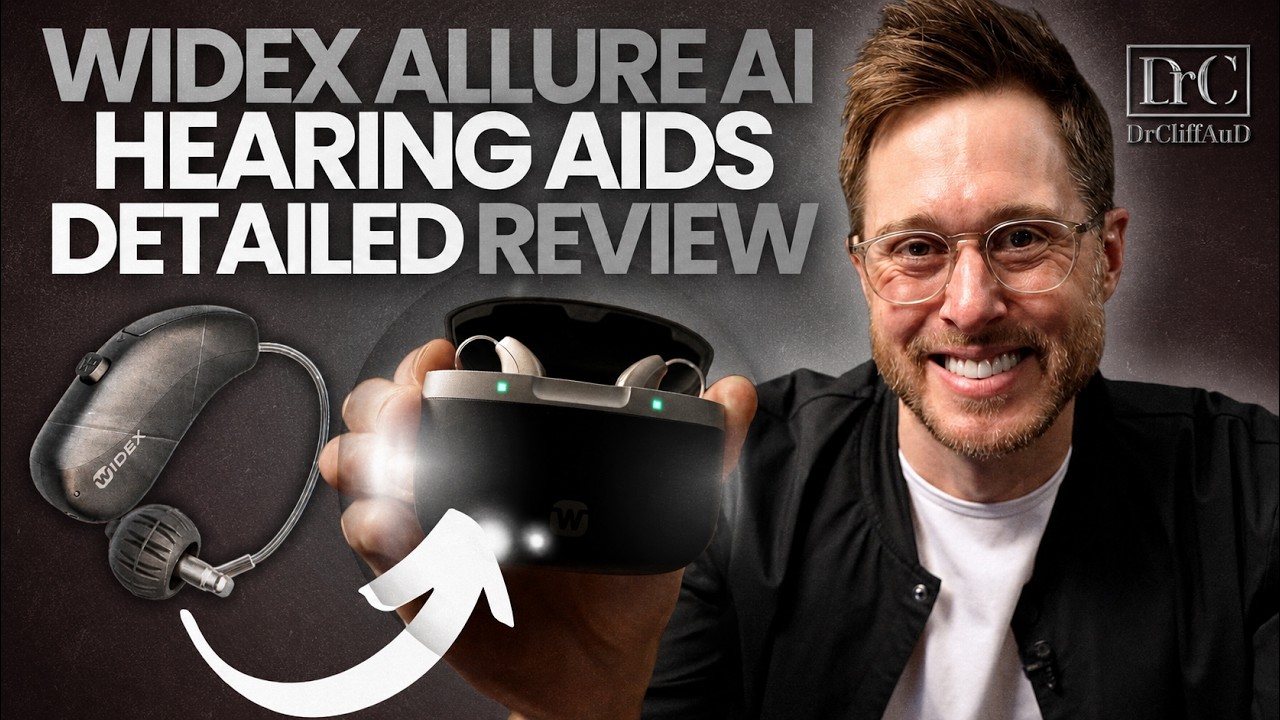
If you're looking for a hearing aid that is truly different than any other hearing aid on the market, this would probably be it. Hey guys, Cliff Olson, Doctor of audiology and founder of Applied Hearing Solutions in Phoenix, Arizona. And in this video, I'm doing a detailed review of the new Widex Allure AI hearing aids. Now, not to be confused with the Widex Allure hearing aids, the Widex Allure AI hearing aids are the first hearing aids from Widex to use a deep neural network for sound processing.
Now, just to be clear, this is not Widex's first attempt at using artificial intelligence inside of their hearing aids. In fact, Widex was one of the early pioneers of machine learning in hearing aids with their SoundSense learn feature inside of their Widex Evoke hearing aids back in 2018. This feature allowed Evoke users to make customizations to their own audio by doing AB comparisons while they were actually in a specific listening situation.
And that was a great start, but Widex decided to take this artificial intelligence to a new level with the Allure AI. Now, in May of 2026, I got to have a little sneak peek of the Allure AI hearing aids during my trip to Widex headquarters in Denmark. If you have not yet seen that vlog, I'll go ahead and link it in the description for you so you can watch it after this video.
But I've essentially been evaluating these hearing aids ever since that trip, so let me go ahead and show you what these hearing aids can do. But I've got to give you a quick disclaimer first. You see, it does not matter how awesome the Widex Allure AI hearing aids are or how good any hearing aids are for that matter, unless you've had them fit and programmed by a hearing care professional who follows comprehensive audiologic best practices.
However, finding one of these rare providers can be extremely difficult, which is why I highly recommend that you check out my website, hearingup.com, and find a HearingUp network member in your area. All providers in the HearingUp network have been vetted and are committed to providing comprehensive audiologic best practices when it comes to fitting and programming your hearing aids, as well as providing you with excellent follow-up care.
So if your goal is to get the absolute maximum amount of benefit from your Widex Allure AI hearing aids, then finding a HearingUp network member in your area is your best bet. Now I'm going to be honest here. The White X Allure AI hearing aids are a heck of a lot like the Widex Allure hearing aids that were released in 2025. In fact, many of the features of this hearing aid are exactly the same all the way down to how the hearing aid looks.
I'm going to go ahead and share what these features are before I get to the most exciting part, which is the new artificial intelligence inside of these hearing aids. Feel free to skip forward to that part of the video if you're already very familiar with the Widex Allure hearing aid, and I will have all of that timestamped down in the description. Now, the Allure AI hearing aid only comes in a receiver in canal form factor like you see here.
It is relatively slim and it does come in a variety of different colors that you typically want to match to either your hair color or your skin color. So let me go ahead and put this on for you guys so you can see what it looks like in my right ear. I can go ahead and take my glasses off if that helps a bit, and I slide them right back on.
Really comfortable hearing aid, no real changes there. And I like how they kept it relatively slim so it doesn't push out my ears at all, even when I'm wearing my glasses. Now, your hearing care professional can select between a medium receiver or a power receiver, and they have a variety of different domes that you can use with these hearing aids, and you can also use custom ear molds from Widex.
All of this depends on the severity and configuration of your hearing loss, but generally speaking, you're going to be able to use these hearing aids anywhere from a mild level hearing loss up to a severe level hearing loss. Now, it appears as though Widex is going to be releasing these in two different technology levels, the top tier 440 and the second tier 330. I wouldn't be surprised if they eventually choose to release the level 220 and the entry level 110s.
Now, as you can see, the differences are subtle between these two technology levels, the 440 and the 330, which can make it difficult too impossible to quantify the differences in performance. As usual, anytime that you drop down in technology level, it takes features and customizations away from your hearing care professional when they're attempting to optimize the performance of these devices for you. However, it does not guarantee that you will drop performance if you go from level 440 down to level 330, although there is the potential that you'd be leaving benefit on the table, not just now, but into the future as well.
Of course, this also reduces the cost of the hearing aids anytime that you drop down in technology levels. So I generally recommend the exact same thing to everybody, which is you should be going with the highest level of technology you can reasonably afford, and if you cannot afford it, you need to drop down to whatever level you can afford, and then it's the job of your hearing care professional to maximize the performance of those devices for you.
As far as the cost is concerned, you guys already know that I do not like to share cost in my videos for several reasons. After all, the cost can vary by thousands of dollars per hearing aid, depending on the technology level that you go with, what services are included with those hearing aids, what the quality of those services are, and where you live. So any price range that I give you would be totally incorrect.
Now, the biggest thing that I notice when I look at the spec sheets for the Widex Allure AI hearing aids is the amount of frequency adjustment bands that they have. The top tier 440s only have 15 frequency equalizer bands. And when you drop down to level 330, you only get 12 frequency equalizer bands. This makes it extremely difficult to match your hearing loss prescriptive targets when you're using real ear measurement to verify the programming.
Contrast this with up to 24 frequency equalizer bands for several other major hearing aid manufacturers in their top tier technology. Now, this may not be a deal breaker when it comes to Widex hearing aids for you because you have to remember that Widex focuses more on the timing characteristics of sound rather than the frequency characteristics of sound compared to these other manufacturers. This philosophical difference is actually what gives Widex their unique sound quality that a lot of people have preference for, and why so many individuals who love listening to music have a preference for Widex hearing aid technology.
As you could probably tell, the Allure AI hearing aids only come in a rechargeable option. This is the rechargeable case right here. I love how they have a lid on it. The well inside of there isn't too big, so if you need custom molds, it might be a tight squeeze in there. But when you're looking at it from the perspective of using a rubber dome on the hearing aid, there of course is plenty of room inside of there.
Now the case itself does store three additional charges. You can see the green lights on the bottom of the case, and it uses USB-C charging, so it basically uses the same charging cable as other electronic devices in your house. The hearing aids themselves have 22 hours of battery life on a single charge, and it's super quick to charge these devices. In most cases, I'm topping off my battery at the end of a full day with about two hours of charging time.
If you're completely dead on the batteries, it'll take you about three hours. Now, the hearing aids themselves do use charging contacts. You can see them there at the bottom, so you do have to make sure that you keep those clean because if they are not clean, they will lose connection with the charger and then they won't charge. So far, the charging has been extremely reliable during this review process, which I greatly appreciate.
All right, let's go ahead and jump into the Bluetooth. And I'm going to be honest, this was a little bit rough for me. First things first, when I went to connect these hearing aids up with my Apple phone, everything went super smoothly. It only took me about two minutes to get the connection. However, in order to get these to connect with my Samsung Galaxy S25 phone, it took about 20 minutes.
The process was not smooth. It kept telling me that it couldn't recognize one of the hearing aids or that it only paired the other hearing aid. And then when I went into the app, it actually showed that both were paired, so it was just confusing overall. Now, the Allure AI hearing aids do have multiple forms of Bluetooth. They have Bluetooth low energy for the iPhone connection. They have the ASHA Bluetooth protocol for certain Android phones, and they have the new LEAudio Bluetooth, which is fantastic because that means that they will have access to Auracast broadcast audio.
One feature that I really like about the Bluetooth streaming is that it gives you an option to have speech streaming media or music streaming media, and you can definitely tell a difference between the two. I definitely prefer to be on the correct setting when I'm streaming different forms of media, and you can change it if you want to. However, this is where things got a little bit more rough.
So with the iPhone, everything paired up easily, but if I set this phone down and I go and walk like 10 feet away, the audio cuts out and it is absolutely a horrible experience. Perhaps I need to get a newer iPhone. I'm not really sure, but every time that I disconnect it and reconnect it, thinking that that might fix the issue, the problem stays the same. Now, it's a little different when it comes to my Samsung phone.
So the audio quality from my Samsung phone is really stable when I walk away from it. I can get substantially further away from my Samsung device than I can my iPhone. However, there is some weird artifact stuff going on from my Samsung device. It's like there's a second or two of harshness that comes about every once in a while, and I can actually force it to happen by increasing or decreasing the volume while I'm streaming.
If I stop the streaming and start the streaming, I'll get it. If I switch into a different app while I'm streaming, I get some harshness there. It's really not tolerable. And then there'll be other occasions where it doesn't happen at all, and then I'm like, "Should I even talk about that in my review? 'Cause it seems like it fixed itself." And then I'll start streaming again a little bit later and the same problem comes back.
Now, I do not have that same problem with my iPhone. The iPhone sounds clean. So it probably has something to do with the Bluetooth that they're using for each of these devices. I imagine that they're using LE Audio for my Samsung device, and of course, Bluetooth low energy for the iPhone. Perhaps this stuff will be ironed out by the time these hearing aids actually hit the market.
This is going to be something I pay extremely close attention to with my patients when they're in their fitting sequence, because if they run into that issue and we can't fix it, it's going to be a problem. I should also mention that Auracast is not technically available yet in these hearing aids. It is going to require a firmer update in the future. Honestly, I'm not really sure why any hearing aid nowadays would not have Auracast be ready to go right out of the box.
As you know, I'm making a big push in the greater Phoenix area to get public venues on board with installing Auracast transmitters, so you can go with your Auracast-enabled hearing aids into these public venues and stream audio directly into your ears at a much higher song quality than any other options that are currently available. The last thing I need is for these venues to ask me if all hearing aids can utilize this technology, and I have to tell them no.
Of course, this Bluetooth also gives you access to the Allure app. Now, if I show you this right here, you'll see part of the issue. You see how it says that I'm not fully connected with the left hearing aid? I have them both paired and in my ears, but for some reason, it will not show that it's connected, which means if I go in here and I start making some adjustments, it's not actually going to reflect inside of the left hearing aid.
Now, sometimes when I go in here, it shows that it's connected and I'm like, great, I'm back in business, but then the next time I go and check, we're disconnected again. Now let me briefly cover a couple of things you can do inside of the app. The app really does need its own review video, but if we tap on this, it'll actually show us what the percentage of battery life is inside of there, if it connects to the hearing aid.
You can see that we have a variety of different program options that I've programmed into these devices, including that new ClarityBoost program, which is where the AI is housed. I'll cover that here in a minute. You also have the ability to control directional microphones, which is pretty cool. Of course, I can only do it for my right ear right now. I don't have a left option because it isn't recognized that I'm wearing my left hearing aid.
You of course have a frequency equalizer band that you can do. You can also do frequency equalization while you're streaming audio, which is very nice, and there's different presets that you can use for that too. Still have the ability to activate the AI Sound Assistant, which is kind of like the Sound Sense Learn feature from the Evoke hearing aids when they came out a number of years ago.
And you also have the ability to use the AI Quick Assistant still. Last but not least, of course, you can go in here and adjust the volume of your hearing aids either together or separately. And as you can see, it's only adjusting the right one because that left one just will not connect. Of course, some notable things that you do not get inside of the Widex Allure app is the ability to do remote care with your hearing care professional.
That is still not available on the Allure AI, unfortunately. Now I might be the most upset person when it comes to this because I have a lot of patients who travel from a very long ways to come see me in the clinic, and I'm no longer able to make remote adjustments on their hearing aids with these devices. And another notable thing that is missing, of course, is because Auracast is not enabled yet.
There is no Auracast enabling option inside of the app at this time. I do imagine that will come available for both Android and Apple devices when they do release that firmer update though. Okay. Now let's get into what makes the Widex Allure AI hearing aids different from the original Widex Allure hearing aids, which is the artificial intelligence. Now, unlike the original Allure hearing aid, the Allure AI uses a deep neural network for sound processing in one of their programs.
You can essentially think of a deep neural network as an artificial human brain inside of a computer system that has been trained to recognize different sound patterns. When this artificial brain is fed thousands of hours of different sound samples, essentially it learns the differences between speech and noise. After this training has occurred, it makes a hearing aid better capable of amplifying for speech and reducing the amount of amplification for background noise.
So how is Widex doing this differently than other hearing aid manufacturers at this point? Well, inside of the Allure AI hearing aids, they are using a dual chip architecture. The first chip called the W1 is running all of Widex's traditional sound processing very similar to the original Widex Allure hearing aid. The second chip is a dedicated artificial intelligence co-processor that is responsible for running the deep neural network.
Not to bog you down with too many of the details here, but in order to accomplish this, WEDEX first developed a large audio foundation model. Essentially, this was a much larger AI system that they were able to train with thousands of hours of real world sound samples. They then took everything that that large model learned and trained a smaller deep neural network that they were able to actually fit inside of the Widex Allure AI hearing aids.
This way they were able to maintain good battery life, reduce processing delays, which is something that Widex is known for, and keep the size of the hearing aids respectable. And like I mentioned earlier, Widex decided to keep this artificial intelligence inside of a singular program called Clarity Boost. This way they were not altering the performance capabilities of their other programs like the Universal Program or Pure Sound.
It's also important to know that you have to manually activate this Clarity Boost program. It will not automatically switch into it for you. Now, this type of a strategy, in my opinion, does have its advantages and its disadvantages. The advantage is, is that you get to activate it when you want it to activate. It's not going to switch into that automatically when you don't want it to go into it.
You get to be in full control. Personally, I prefer it to activate automatically. The reason why is that a lot of hearing aid users do not manually change their programs either because they don't remember that they can, or they're just not willing to take the time to do so. According to Widex, they actually made an intentional decision to do this so that AI sound processing didn't have a change on your everyday listening experience with their devices.
Of course, the most important question here is whether or not the Clarity Boost program that uses this artificial intelligence actually significantly improves your hearing when you're in a noisy situation. And the answer to that is kind of complicated. After testing this program myself over the past several weeks in a variety of different noisy environments, I will say that I can notice a difference when I switch into this Clarity Boost program, but it's not as dramatic as the change that I experienced with other hearing aid manufacturers switching into their artificial intelligence programs.
However, this is also intentional by Widex, because according to Widex, they wanted to preserve the type of sound quality that Wide hearing aid users have grown accustomed to. And if they remove too much of the background noise, it could make their hearing aids sound less natural. Although I would argue and make the point that if you're in a situation where you really need to be able to hear someone talking to you, but it's just too noisy, you're probably willing to forego some of the natural sound quality in order to get better speech understanding in that environment.
Now, when I compared the ClarityBoost artificial intelligence program with the Universal Program and the Pure Sound Program in Noise, all three of those programs retained what I would call the Widex signature sound. But ClarityBoost clearly changed the perception of what I was hearing to where I could tell there was a difference in the processing strategy. I did not notice a massive drop off in the background noise when I switched into Clarity Boost, but I do notice that I can understand speech even though the background noise doesn't completely go away.
But based on what I know about Widex's sound processing strategy using the Clarity Boost artificial intelligence program, this is probably what they're going for. All right, so what are my final thoughts about the Widex Allure AI hearing aids? Well, I've got to say that these devices are a heck of a lot like the Widex Allure devices, and based on my review capabilities, I would say that they're nearly identical except for the Clarity Boost Artificial Intelligence Program.
On top of that, the Clarity Boost program does not give you that like aha moment like I first experienced with the first deep neural network hearing aid that I ever tried. Although it does augment the sound quality of the Allure AI devices in a way that gives you a different perception of sound compared to the other programs that you would have inside of them. And so there is some utility to that.
If we talk about Bluetooth connectivity, I have to say that my experience with the Widex Allure AI devices was rough at best. When the streaming sounds clean, they sound great. When the streaming does not sound clean, it's almost unusable. And personally speaking, I would prefer if these hearing aids were Auracast capable right now so I could activate my Auracast inside of my office and show patients how it works.
I'm still a little bit bummed that Widex has not reintroduced their tinnitus masking sounds using the Zen fractal tones and the Relax sounds. These masking sounds were a big reason why a lot of tinnitus specialists would recommend Widex hearing aids, and that feature is still not available inside of these AI devices. Now I don't want this to take away from how good these hearing aids really are.
These are really good hearing aids. And chances are, if you're someone who loves the way that Widex hearing aids sound, you're going to love these two. On top of that, if you struggle with other hearing aid brands, it could be the way that those brands are processing sound. And remember, Widex takes a completely different approach to sound processing compared to every other hearing aid manufacturer out there.
This means that the Widex Allure AI hearing aids may be a better fit for you. Now, Widex is not trying to win the artificial intelligence race for how aggressive they can make their AI. Based on what I can tell, Widex is choosing to prioritize their sound processing philosophy, which is what a lot of their dedicated users have grown accustomed to over the years, while still giving users an additional boost when it comes to understanding speech and background noise.
But at the end of the day, it really depends on how skilled your hearing care professional is at maximizing the performance of these devices and whether or not they're going to follow a comprehensive best practice fitting protocol with you. But if Widex's approach to sound processing is something that appeals to you, these hearing aids are definitely worth considering. I